Pages

Friday, May 16, 2014

A cubic gives cubic

I ask you a question and the answer is very simple. But it has a very interesting conclusion in it. The question is "If we take a cubic equation and consider A as one number. Now If we find the difference of the roots from this point A and frame an equation which gives the values. What will we get."

The answer is very simple and is a cubic. The expression will be a cubic because we know that there are three roots and each value will be at a constant distance from the given number A. So there will be three numbers and a cubic equation only gives three values i.e. three numbers when equated to zero.

Now the question arises how can we find that equation. Suppose the equation is f(x) and the number is A. Then, the required equation is
f(x+δ) = f(x) + f'(x)δ /1!+ f''(x)(δ)² /2!+ f'''(x)(δ)³/3! +...

The above equation can be helpful for a cubic if we know one root.

Suppose the equation is f(x) = (x - 1)(x - 2)(x - 3)
= x³ - 6x² + 11x - 6

Now as 1 is a root then
f(1+δ) = f(1) + f'(1)δ/1! + f''(1)(δ)² /2!+ f'''(1)(δ)³/3!
f(1+δ) = f(1) + (3x2 - 12x + 11)δ + (6x - 12)(δ)²/2 + 6(δ)³/6   x=1
f(1+δ) = 2δ - 3δ² + δ³
f(1+δ) = δ(2 - 3δ + δ²)
For the other roots f(1+δ) = 0 So,
Solving, δ(2 - 3δ + δ²) = 0
we get, δ = 0,1,2. Hence the roots are 1,2,3.

Thursday, May 8, 2014

Method of differences

There are many occurrences when we have certain numbers and we have to find relation between them. The relation is usually in form of expressions. The expression can contain log function, exponential function and algebraic functions.The simplest among them is to find polynomial expressions.In this post I will describe how to find functions when we know a series which has its terms separated by certain constant. The method is similar to differentiation but a lot different from them.

Suppose we have the numbers (from a function) like given in the following table

161528456691
We find the difference of successive term
5913172125
We again find the difference of successive term
44444
We find the differences till we get a constant term for all

As we got the constant term so we can create a table of possible polynomials for all. We start from the bottom.

c''44444
a'x+b'5913172125
ax2+bx+c161528456691

We got a quadratic because we had three rows in the table.
Now we have
f(x) =ax2+bx+c
f(0) = c = 1
f(1) = a + b + c = 6
f(2) = 4a + 2b + c = 15
from f(0): c =1
from f(1): a + b = 5
from f(2): 4a + 2b = 14
so solving the simultaneous equations a = 2 and b = 3 hence the function is f(x) = 2x2 + 3x + 1.
Above it must be known from where the values start for x and what is their differences in each step.

Right Angled Triangle

When we add the squares of 3 and 4 we get 52 or in other words 9+16=25. This property was first found as these numbers. Later with the help of geometry and algebra it was proved that the sides of a right angled triangle follow the rule a2 + b2 = c2, where a,b and c are the length of the sides of the triangle. This theorem was later called as Pythagoras Theorem.

Let us derive this theorem.

The triangles BCD and ABC are similar
we have, BD/AB = DC/BC = BC/AC             (i)
Also triangles ABC and ADB are similar
we have, AD/AB = AB/AC = BD/CB             (ii)
As triangles ABC is similar to ADB.
From above AD/AB = AB/AC ;
AB2 = AD·AC = (AC − DC)AC
=AC2 − DC·AC       from (i)
=AC2 − BC2

Pythagoras Theorem is in a triangle ABC
right angled at B
AB2 + BC2 = AC2

Tuesday, April 29, 2014

Triangles

Let us consider the persons who developed mathematics as one person. Let us call this person as Cofu. Then we could easily understand about the thoughts which was going in the minds of the people who developed mathematics. Human categorizes or differentiate things. They differentiated seasons in different ways and wrote them as tally marks on the walls of caves. Now considering all as cofu. Cofu looked at his surroundings and found many shapes among which was a shape with three sides. He called this shape as triangle. Then he wanted to rigorously study this shape. He found that the triangles may be classified according to the length of triangle's sides. If all the three sides are different then the triangle is called scalene triangle. If two sides are equal then the triangle is called isosceles. If all the sides are equal then the triangles is called equilateral.

As the time passed he developed the method to measure angles. He found that the angles are related to the sides or in other words they depend on each other. If we increase one angle then the side opposite to it also increases and if we increase the sides then the angles opposite to it also increases. If two angles are equal then the two sides are equal in a triangle.


He also differentiated triangles according to the angles. A triangle with one angle greater than 90° is called an obtuse angled triangle and those with all the angles less than a right angle is called an acute angled triangle. If any of the sides is equal to right angle it is called a right angle triangle.

As the time passed he wanted to measure angles. He faced a problem that there are many sizes of triangles and each shape has different relations of sides. After thinking a while he found that every triangle can be decomposed into two triangles with one angle of each triangle right angle. then he thought to develop all the mathematics of triangles according to right angle. We will study about the right angled triangles in the next post.

Monday, April 28, 2014

Bisection Method

There are many methods to find the roots by approximation and one of it is bisection method. This method uses the intermediate value theorem which states that if a continuous curve changes sign then it must have taken zero at some point.

We take the given function f(x) and two values a and b such that f(a)·f(b) < 0. Then we bisect the values a and b. Let it be c. c = (b-a)/2. If f(c)=0 then c is the root else if f(a)·f(c)<0 then b=c else a=c. We continue the same procedure again. This method converges very slowly.

The property of this method is that it does not use the value of f(x) as the formula to compute the root.

Saturday, March 29, 2014

Finding roots by approximations

On looking at the graph of a polynomial, we find that the graph cuts the x axis at certain points if it has real roots. We can use derivatives to find the roots of the equation formed from the polynomial.

In this method we first take a equation (f(x) = 0) whose root we have to find. Then we take a value x1. For that value of x we find the value (y1) of the corresponding expression. We find the derivative of the expression (f'(x)). Then we find the value of the slope (m1)at that point . We find the equation of a line
[(y − y1) = m (x − x1)].
Then we find the abscissa (x2) of intersection of the x-axis and the curve. We follow the same process again for the x2.

This method works very well for quadratic equation. It can work well for cubic equation and may work well for others. The problem which arises in this case is the value of x found. If the value of x found approaches the root then the method works well. There are many cases which arises when we find root by this method. The most favorable case is when we approach the root continuously i.e. every x with odd subscript moves in one direction only i.e. each successive odd term either becomes greater or either it becomes less of its previous. Each term with even subscript becomes greater if its corresponding even term is less and vice-verse. Then we will certainly approach the root.

Let us find the roots for a quadratic equation:

Enter a quadratic Equation:
x2 + x + = 0.
Input a value to start:

Input the number of iterations:

Thursday, February 20, 2014

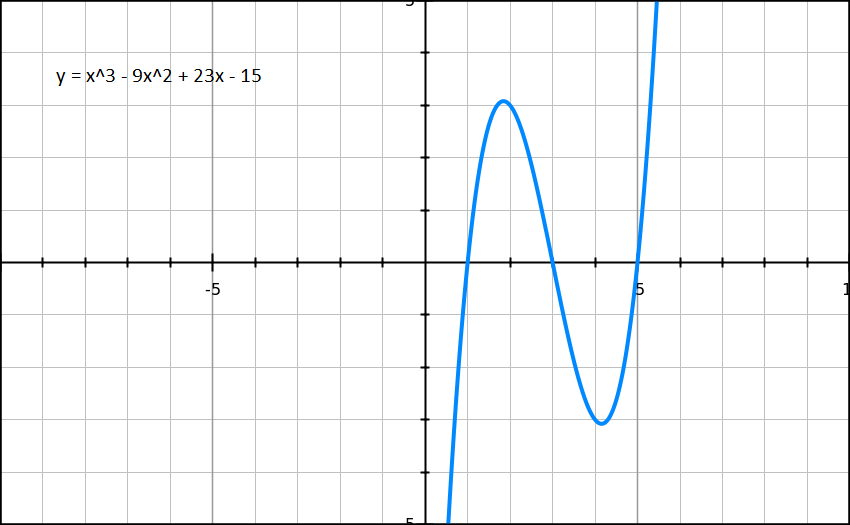
Solution of a cubic equation (Part 1)

In elementary algebra it is of prime interest to find the solution of a cubic equation.In this post and few other posts we will find the solution of a cubic equation. As from the previous post we know that the cubic is symmetric with respect to some x = a. In this post let us find the condition when the cubic expression has the middle point on line y=0 and what are the solutions of the corresponding cubic equation.

Let the cubic expression be y = ax3 + bx2 + cx+ d.
Differentiating y w.r.t. x we get y' = 3ax2 + 2bx + c. Here the sum of the slopes is −2b/3a. Now when we take a particular slope and put it in the equation of y' then we get a quadratic equation. We know that a quadratic equation has two roots. This implies that as the middle point of the curve has both the slopes equal as that point has a unique value. So slope is half of the value −2b/3a i.e. −b/3a. Which we have seen in the previous post. Now we have to find the value of x for which the slope is −b/3a. At this point we know that the difference between the slopes is zero as it has unique value so the rate of change of slope is zero. Differentiating again w.r.t. x we get y'' = 6ax + 2b. We find that the point where rate of change of slope is zero is -b/3a. Equating 6ax + 2b to 0. x has value −b/3a at the point where the rate of change of slope is zero.

Now we will find the value of y for this point. It is
y1 = a(−b/3a)3 + b(−b/3a)2 + c(−b/3a) + d
y1 = −b3/(27a2) + b3/9a2 − bc/3a + d
y1 = 2b3/27a2 − bc/3a + d
When this value is zero then the roots can be found very easily. In this case the center of the curve lies on the axis y = 0. I will tell what are the properties of the roots at the last.
when y1 = 0 then d = bc/3a − 2b3/27a2

Now let us find the value of x where the slopes are zero. We get
3ax2 + 2bx + c = 0
x = [−2b ± √(4b2 − 12ac)]/6a
x = [−b ± √(b2 − 3ac)]/3a
x1 = [−b − √(b2 − 3ac)]/3a
x2 = [−b + √(b2 − 3ac)]/3a
The center root lies at the middle of the points where the slopes are zero.
So,if δ is the distance of the middle root from the points where the slopes are zero then x1 + δ = x2 − δ.
δ = (x2 − x1)/2
δ = [√(b2 − 3ac)]/3a
Hence the middle root is β = −b/3a.
Let the other roots be at a distance p from the middle root. Then
(β − p)(β + p)β = −d/a
(β − p)(β + p)β =− [bc/3a − 2b3/27a2]/a
(β − p)(β + p) = − [bc/3a − 2b3/27a2]/aβ
2 − p2) = [bc/3a − 2b3/27a2]3/b
2 − p2) = [c/a − 2b2/9a2]
2 − p2) = [9ac − 2b2]/9a2
p2 = β2 + [2b2−9ac]/9a2
p2 = b2/9a2 + [2b2 − 9ac]/9a2
p2 = [3b2 − 9ac]/9a2
p = ±√[3b2 − 9ac]/3a
Hence the roots are
α = { − b − √[3b2 − 9ac]}/3a;
β = −b/3a;
γ = { − b + √[3b2 − 9ac]}/3a

Properties of the roots

The outer roots are equidistant form the middle root.
The roots are
α = { −b − √[3b2 − 9ac]}/3a;
β = −b/3a;
γ = { − b + √[3b2 − 9ac]}/3a
if the equation ax3 + bx2 + cx + d = 0
satisfies d = bc/3a − 2b3/27a2